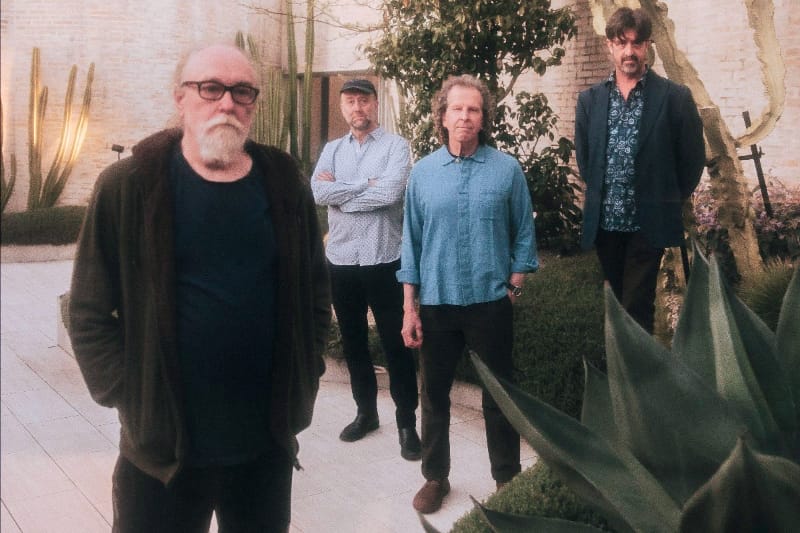
 Ed Kuepper (left) and Asteroid Ekosystem with Alister Spence (second from the rigtht). Photo supplied.
Back in the day, I never saw The Saints with Ed Kuepper. Partly, because they just never got down to Adelaide, and partly because I was in my early teens when they were burning up the world.
I didn't even see the first Laughing Clowns tour of Adelaide but did catch the second tour. Completely hooked, after that I saw every Clowns show in Adelaide.
Traditional bollocks says the Clowns were kinda a jazz outfit. I suppose there were obvious building blocks. But they weren't jazz – and nor were they rock'n'roll. Didn't matter to me, I just danced at every gig, all the way through.
Forty-some years on, I'm a fat wheezy old fart who couldn't dance for half a song without getting puffed and reaching for the Zimmer frame.
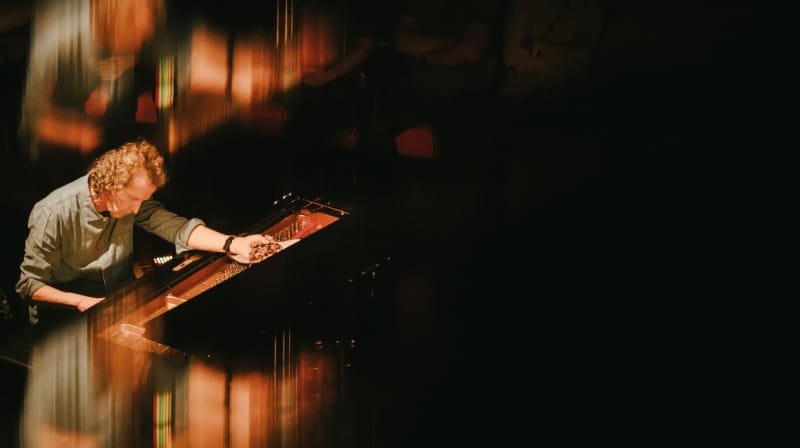 Alister Spence. Jordan Nunns photo.
Which brings me to Alister Spence, the Ed Kuepper associate who has been playing music for decades, since right back during the “punk wars”. If you have the Prince Melon Kuepper disc “Ascension Academy” and the Laughing Clowns “Live Series” volumes 7 and 8, you have Alister in your collection.
Alister Spence’s online cv describes him as an "internationally-recognised pianist, composer, and performer of jazz and improvised music [whose] compositional portfolio spans several hundred works — mostly music for concert performance, and also film, and theatre production".
The bloke is a) brilliant, b) been working in Australia for decades, and c) I'd never heard of him until last week.
Mmmmm. I'm sure he gets the same thing the Laughing Clowns did: “It's not rock but it's not jazz'” Which is as sure a way for people to mutter, “Huh?' and move on.
But this is, as I say, bollocks. Alister Spence is the best new Australian discovery I've made in the last year - and I confess I'm a total plonker for not being aware of him earlier. Sure, you'll just mutter “Huh?” to yourself and put another bunch of dim sims into the air fryer and crack a crafty beer.
No. Don't. Just, don't. Time to give a listen to some sublime, involving, out-there sounds that will (huh, or should) make you feel like you're 17 again and discovering the joy and expanse of music for the first time.
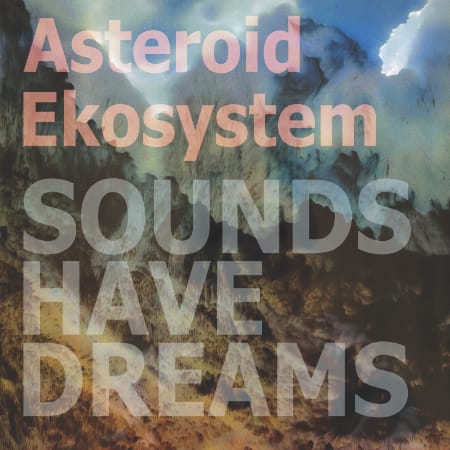
Right now Spence is playing a rare few live gigs with Asteroid Ekosystem (essentially his Alister Spence Trio plus Ed Kuepper) to promote their second LP, "Sounds Have Dreams". I gave it a listen.
After picking myself up off the floor, I fired off a pile of questions to the man responsible.
I-94 Bar: Alister, I see you’ve been working with Lloyd Swanton and Toby Hall for quite a while now. It’s a big history - how long has it been, and how did it all start, and how did it develop to where we are now?
Alister Spence: Hi Robert it’s great to meet you. I’m very glad you like “Sounds Have Dreams”, and thank you for looking into my/our history.
The Alister Spence Trio with Lloyd and Toby started officially in the late 1990s. We were all playing in an original contemporary music jazz band called Clarion Fracture Zone which Sandy Evans, Tony Gorman, and myself were co-leading and composers for. Tony unfortunately was diagnosed with Multiple Sclerosis which affected his playing very badly and the band had to stop playing.
As I remember it, I was asked to play a trio concert and included Lloyd and Toby and we have continued on from there. Along the way we’ve released eight albums and played nationally and internationally including festivals in Japan, Europe, UK, and Canada.
My trio has always been a space where I can write and play what I like. It’s a place to experiment and try out new ideas though of course I consider what we’ve done before and how to carry elements forward.
The idea to play with Ed Kuepper and combine contexts came from playing Ed’s music in bands such as the [re-formed] Laughing Clowns, and the Aints! and other projects, and listening to and really enjoying his special approach to playing the guitar and improvising.
I-94 Bar: What was your first instrument? Do you still have it?
Alister Spence: My dad was a very good piano player and we had a Collard & Collard baby grand piano in the family home when I started lessons at nine-years-old. It’s not in the family anymore. I have a small Kawaii baby grand piano in my house, along with other keyboard instruments: organ, Fender Rhodes electric piano, etc.
I-94 Bar: What made you embark on the perilous journey of musician? How would you describe your creative imperative?
Alister Spence: It took me a while to figure out that this is what I wanted to do. I loved playing and I loved making up tunes and improvising and playing in a band with my brother and other high school friends (we played strictly original, instrumental pieces) but didn’t give myself the permission to try making a go of it until I was about 25. Before then I’d been a primary school teacher for a short while.
In 1985 when I was 30, I was accepted into a Diploma in Jazz Studies at the Sydney Conservatorium and that’s when I started to meet and play with a wider network of musicians. I’d started to look into jazz more deeply. As a teenager I was into British rock bands Black Sabbath, Led Zeppelin, Deep Purple, and others, so I wasn’t really a jazz fan, I just wanted to know more about how to improvise and jazz provided a path. And along the way I knuckled down and began to learn the craft.
It’s difficult to describe my creative imperative: music has always had a hold on me, and I find playing the piano gives me something I can’t get anywhere else. It draws me in very deeply and provides an outlet for expression like nothing else I’ve ever known. And it continues to do that, that feeling has never changed.
I-94 Bar: I notice that you name-check Morton Feldman’s book, “Give My Regards to Eighth Street”. Has his work - especially with "indeterminacy" - influenced you? And, just for fun, could you explain what indeterminacy means to you? Why is it significant - or is it?
Alister Spence: Yes, Feldman’s work and writing has had a big influence on me. I’ve only become aware of the connection fairly recently when I was preparing to begin my PhD in 2013. The Experimental Music movement in America - and also its counterpart in, for instance, Free Jazz - really helped to provide a good perspective on my musical interests and approach. I’ve always been drawn to the unexpected things that happen in music-making; the accidents, coincidences, contingencies, that result in work that John Cage describes as “the outcome of which is unknown.”
Allowing or creating indeterminism and uncertainty, into the music process can enable freedoms and fresh-sounding results. I/we take this approach in Asteroid Ekosystem.
I-94 Bar: In a mainstream music world, what do you think the term "jazz" conjures up - and what does the term mean to you?
Alister Spence: Actually I’m with you as you said in your introduction to these questions. I don’t pay too much attention to music genre terms. It only gets complicated when I have to explain where my music might fit. I think the jazz is pretty audible in my playing, but only because It’s something I’ve put a lot of time into learning.
I have a good friend, Japanese pianist/composer Satoko Fujii, who describes jazz in terms of the freedoms that it allows to borrow and absorb different musical influences. In my view that’s where jazz started and that’s its usefulness for me.
I-94 Bar: In a recent interview, Sleaford Mods musician Andrew Fearn ignores the interviewer trying to pigeon-hole what style he makes by remarking, "It’s all music, isn’t it?”. Why is it, do you think, that we seem to feel the need to define something, in order to file it away?
Alister Spence: This comes up a bit, not with you I think, but with a certain type of reviewer who is seeking to understand something according to their existing framework of what belongs and what doesn’t: which of course is silly! If it connects with you, it connects! And we will figure out eventually the various strands of music that might have contributed to the result. We don”t have to show ourselves clearly as being card-carrying members of a particular club, and who administrates that club anyway?
I’ll bring in my friend Satoko again: she says that there are two types of music listeners, ones that like hearing what they know, and ones that like hearing what they don”t know.
I-94 Bar: Certainly Asteroid Ekosystem play involving, groovy music which conjures up many moods during each song’s course (“Perpetual Fantastic”, for example). How on earth does everyone head in the same direction when recording?
Alister Spence: I’d say a lot of that comes down to each musician’s highly developed musical radar, and also It’s due to the amount of time we have played together and the different contexts we’ve been in. All the players in Asteroid Ekosystem thrive on making in-the-moment decisions, and also they are always considering their contribution to the whole sound at the moment and how it might go forward and develop.
When it came to the band recording session I had written some “road maps”; sometimes just a couple of sentences describing a style or concept, and sometimes a chord sequence, or bassline and simple song form.
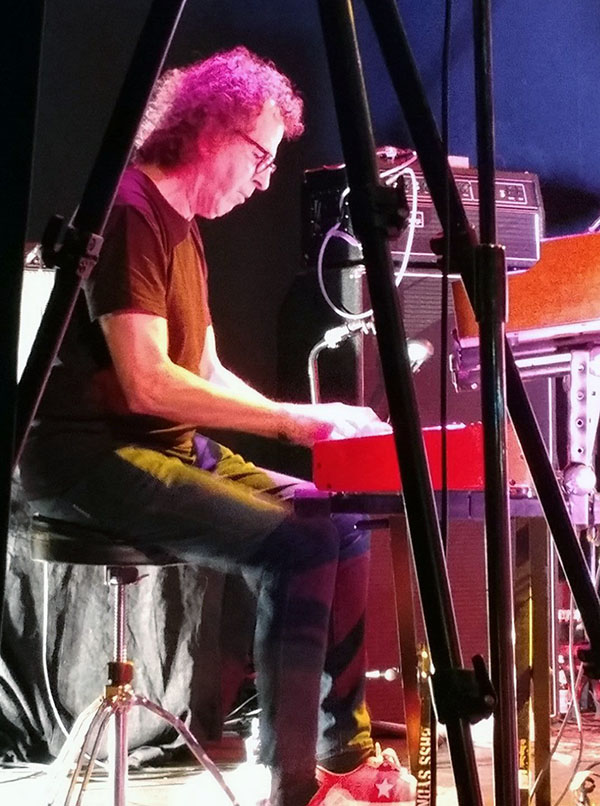
On stage with The Aints!
I-94 Bar: When I first heard the name of the band, “Asteroid Ekosystem” (a week ago), I thought it was dreadful. However, after hearing the new LP, “Sounds Have Ears”, I thought, "well, that’s a perfect description". This LP has elements of floating, often in a deceptively beautiful but cold and incredibly hostile environment, with interrupted purpose. But such a description seems to me to trivialise the effect of the music. If I were to put this record on for my punker friends, what should I tell them about you, and your intent?
Alister Spence: When I was thinking about this album I really wanted to bring the special, angular, atonal-sometimes-and-beautiful-others, things that Ed does into the centre of the music. That’s why I recorded him first solo (in Brisbane for one day in 2024) and then designed frameworks or approaches that we could try as a band would go with these recordings.
On the album you hear Ed’s guitar from 2024, and also from the 2025 band recording session, sometimes at the same time. I love exploratory, happenstance-driven, devil-may-care approach that Ed sometimes takes, and his sound-colour world which crosses over so many different types of music, and I love the energy of rhythm-driven music - often rock in this case, and sometimes jazz - and the opportunities it provides for risk and exploration.
BTW, you probably know but the name “Asteroid Ekosystem” started by playing around with combinations of Alister Spence Trio (“AST in Asteroid”), and Ed Kuepper (“EK in Ekosystem”). I think the band is very much its own thing but that’s where it started.
I-94 Bar: A bunch of years ago I saw Ed Kuepper do a rather magnificent set incorporating (for once) feedback (he was using two amps as well). There’s a couple of Aints LPs which I love - especially the first studio LP - so for me he’s an inspired choice for your Trio to work with. How did you come up with the idea to work with him, and could you explain a little of how the Trio adjusted to play with him?
Alister Spence: I first played with Ed in 2007 when he was asked to perform “Honey Steel’s Gold” at the “Don’t Look Back Festival”. From then I’ve played with Ed in a range of different projects such as when the Laughing Clowns was reformed for “All Tomorrow”s Parties” (2009), with the Aints!, and also with The Exploding Universe, and other things in between.
When it came to asking Ed if he was interested to join with me, Loyd and Toby on a new recording in 2019, I’d been listening to him a lot, and playing with him, and loving where the music went, and I thought it could be pretty special to try this combination. Fortunately Ed thought the same!
I don’t think the trio has adjusted much at all to play with Ed, It’s just been a matter of creating a context we can play and play off each other, and very quickly I think we”ve all found a way forward together.
I-94 Bar: Asteroid Ekosystem seem like the kind of band made for playing live - will we be seeing more of you (particularly in Adelaide)?
Alister Spence: I hope so! It’s a bit one step at the time at the moment. Ed has just had a brilliant overseas tour and always has other things on the go, and Lloyd is very busy with The Necks who now tour three times a year. So we have to fit around this. But yes I think we are a great live band, and I’m hopeful we will travel more in Australia later this year and into next.
I-94 Bar: What’s the response been like from Ed’s fans? Or hasn’t that come up?
Alister Spence: The fans I’ve heard from absolutely love Asteroid Ekosystem! It provides a way for Ed to do things as a guitar player he doesn’t always get to do in other settings, and puts him in contexts that reflect a wide range of his musical influences. The double bass and piano are acoustic but the energy and drive are front and centre when needed.
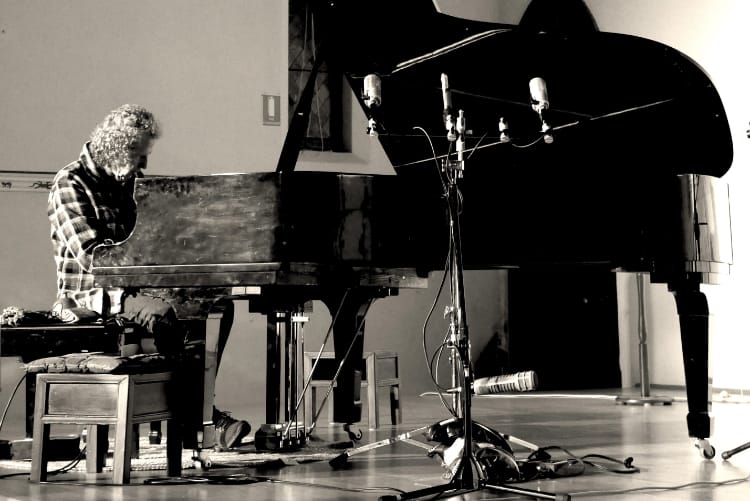 Rachel Knepfer photo.
I-94 Bar: Have you done soundtracks to any films, at all? I would’ve thought both bands would lend themselves to this medium?
Alister Spence: I have done quite a bit of film composition, especially some years ago with First Nations film maker/director/composer Ivan Sen including his first feature film “Beneath Clouds”, and Ed of course played the music to “Last Cab to Darwin”, but we haven’t played for film together as a band.
I-94 Bar: You’ve won APRA/AMCOS/ AMC awards, and won and been nominated for, a positive raft of others: these are major achievements in anyone’s career. What drives you forward?
Alister Spence: It’s a bit hard to know! I’m getting older and sometimes feel a bit worn out, but I really like making music and playing with the incredible people and musicians that I have the honour to make it with, and this keeps stimulating new ideas about what could happen next.
I-94 Bar: Most of my friends in bands find that they have to work a job. It’s not that bands don’t pay any bills, but it seems difficult to make a living in the current climate. What changes have you noticed during the last 25 years?
Alister Spence: I don’t think this has changed much at all in the years I’ve been working as a musician (and supplementing my income by teaching at University of New South Wales) . Depending on the type of music you are involved in opportunities may be limited; certainly that is the case in Australia. It’s part of what we have to accept - and yet still push against - if we decide to take this path.
I-94 Bar: Rock guitarists seem to collect guitars. Do you have multiple pianos/ keyboards?
Alister Spence: Haha no! We have a small house! I have the keyboards that I’ve needed for the work I do: grand piano, electronic organ, and a Fender Rhodes electric piano. I also have some smaller keyboards; a synth, another small organ.
I-94 Bar: Favourite piano to play? or does it depend on the outfit?
Alister Spence: Probably a Steinway D concert grand piano, though I’ve played quite a few other wonderful pianos.
I-94 Bar: Which? Monk, Ellington, Waller, Byard, or Dr John?
Alister Spence: Not which; all! All were great and many besides including Cecil Taylor, and more contemporary players such as Satoko Fujii, Myra Melford, Magda Mayas. All doing their own distinctive thing on the piano.
I-94 Bar: What books have impressed you recently?
Alister Spence: I really enjoyed “Orbital” by Samantha Harvey, and “Praiseworthy” by Alexis Wright, though it took me ages to read it! “After Finitude” by Quentin Meillassoux.
[Robert interrupts here: “After Finitude: An Essay on the Necessity of Contingency” is contemporary philosophy; Meillassoux "proposes a new alliance between philosophy and science and calls for an unequivocal halt to the creeping return of religiosity in contemporary philosophical discourse." Get your local bookshop to get it in.]
I-94 Bar: Five favourite books about music?
Alister Spence: In no particular order (and the ones I can remember at the moment):
“Give My Regards to Eighth Street” (interviews with Morton Feldman); “Steve Lacy: Conversations” (by Jason Weiss); “On Sonic Art” by Trevor Wishart; “Silence” by John Cage; and “Audio Culture: Readings in Modern Music” by Christopher Cox Daniel Warner.
I-94 Bar: Five favourite auto/biographies?
Alister Spence: Some listed above plus biography of Cecil Taylor by Phil Freeman, and “Organic Music Societies” about Don Cherry.
I-94 Bar: Five favourite records?
Alister Spence: Some, across my history:
“Deep Purple in Rock”; “Led Zeppelin IV”; “Kind of Blue” and “Bitches Brew” by Miles Davis; “Footloose” by Paul Bley; John Coltrane “Live in Seattle”; “Alive in the House of Saints “ by Myra Melford; and “Universal Consciousness” by Alice Coltrane.
I-94 Bar: Five favourite downloads?
Alister Spence: Hahaha, I’ll stop here!
I-94 Bar: Just as well but you didn’t get to answer the question about the best dungeon synth bands.
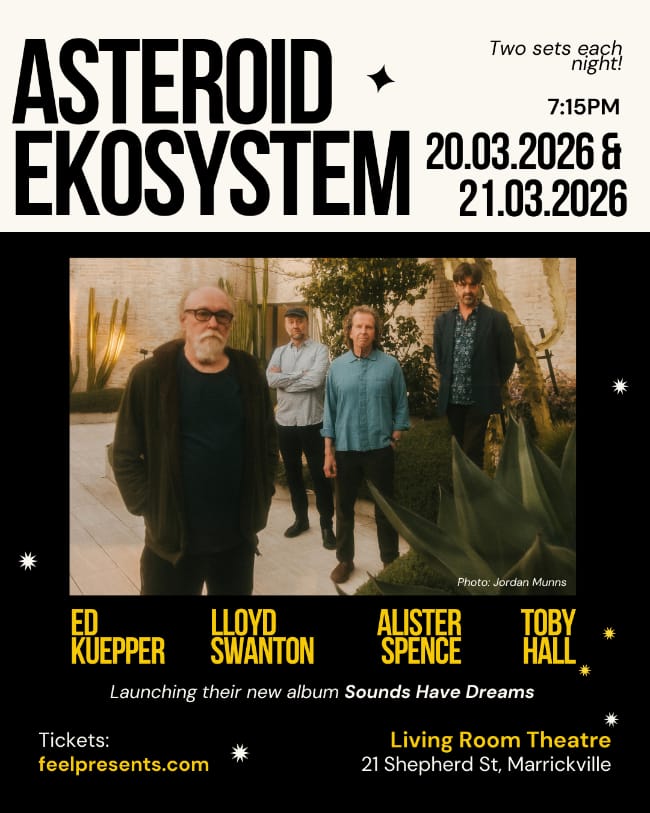
Asteroid Ekosystem plays Sydney launch shows on March 20 and 21 at 21 Shepherd Street, Marrickville, hosted by the Living Room Theatre in connection with Feel Presents. Remaining tickets are available here.
Sounds Have Dreams is out now on CD and download via alisterspence.bandcamp.com, and at all good independent record stores via Magnetic South Distribution. The self-titled debut (2020) and "Asteroid Ekosystem Live (From the Great Club)" are also available